What does a comma do. I have refused them so often and left them out so much and did without them so continually that I have come finally to be indifferent to them. I do not now care whether you put them in or not but for a long time I felt very definitely about them and would have nothing to do with them.
As I say commas are servile and they have no life of their own, and their use is not a use, it is a way of replacing one’s own interest and I do decidedly like to like my own interest my own interest in what I am doing. A comma by helping you along holding your coat for you and putting on your shoes keeps you from living your life as actively as you should lead it and to me for many years and I still do feel that way about it only now I do not pay as much attention to them, the use of them was positively degrading. Let me tell you what I feel and what I mean and what I felt and what I meant.
No one has ever accused Gertrude Stein—her memory IS a blessing, dear reader—of having too few feelings when it comes to punctuation. I adore Stein’s remarks, rambles, thoughts, observations, and passionate recollections of her life lived with punctuation. Particularly the much-maligned comma. I always tell my writing students: “Gertrude Stein didn’t use commas because she said her readers knew when to breathe” (it’s true; see the block quote a little further down). But it’s probably more truthful to say that Stein enjoyed the adventure of the page and the sentence without direction, like not receiving a program for a theater or musical performance. Don’t spoil the arrangement for Stein: let her discover whatever is about to happen. But I also love how Stein describes the work of the comma, even while she is giving it a good bashing as being “servile”—after all, isn’t it nice, sometimes, to have someone or something be attentive to you? Someone to hold your coat? Bring you a cup of coffee? Put your shoes on? I think, in this hard life, we deserve a little ease. Especially in a college essay, or in a piece where clarity and organization are of utmost importance. As Rules for Writers gently suggests, “The comma was invented to help readers” (Diana Hacker, 266). All punctuation is about musical notation—how long we are pausing between our words, phrases, and sentences—and while the comma offers us a minor pause, it is a useful one. I wrote this about the comma:
Oh, the sweet comma. The pause. It sets apart phrases. It helps you list items, say names, dates, and places, and be clear and organized. It also lets your reader (and you) breathe. Read your work aloud, and notice your pauses. But don’t place a comma simply because you stopped typing.
Stein has more to say about the comma and, tellingly, she even indulges us with using a few commas as she does so. I think this is a lovely note to close on, because it opens the door to the pleasure of complicated sentences, and turns use away from use, and towards pleasure. After all, on the spectrum of use and pleasure, explicitly creative writing (essays, poetry, screenplays, short stories, novels, graphics) bends towards pleasure, and away from usefulness. So I will close this brief piece on the comma with Stein championing the complicated sentence, and the pleasures of forgoing the comma, even while using the comma, and showing that sometimes, you just need a sweet, minor pause:
A long complicated sentence should force itself upon you, make you know yourself knowing it and the comma, well at the most a comma is a poor period that lets you stop and take a breath but if you want to take a breath you ought to know yourself that you want to take a breath. It is not like stopping altogether has something to do with going on, but taking a breath well you are always taking a breath and why emphasize one breath rather than another breath. Anyway that is the way I felt about it and I felt that about it very very strongly. And so I almost never used a comma. The longer, the more complicated the sentence the greater the number of the same kinds of words I had following one after another, the more the very more I had of them the more I felt the passionate need of their taking care of themselves by themselves and not helping them, and thereby enfeebling them by putting in a comma.
Writing prompt: Write a prose poem/paragraph or lineated poem (written in lines) without commas. Observe what happens when you write without the comma. What other punctuation do you use? How do you replace the comma? Do your sentences shorten? Do they stay the same? If you choose to lineate your piece, do you use the poetic line/lineation as a comma replacement? Extra points for including a seasonal (it’s October) flower.
The colon introduces new material: ta da! It can also introduce a list, a quotation, a summary or explanation. It’s direct in tone, and draws attention to what follows it. I love its bluntness, it’s honesty. So often, students ask me—
“Will I get in trouble for using this punctuation mark? Can I overuse this mark?”
“You don’t get in trouble for using a period,” I tell them. Today I told a student that they are getting in trouble because they are using a comma when they should be using colons, semicolons and em-dashes. Your sentences are more complex than that—which is a good thing, I reminded them. Time to play with more advanced punctuation, because your sentences are growing up from simple sentences.
I worry that college comp courses seek to iron out what is interesting in a student’s writing—the expressive fragments, the musical repetitions, the comma splices that are doing interesting work (check out Alice Notley, who regularly uses comma splices, ha). Learn the rules of grammar and punctuation so you can PLAY, y’all. It’s like learning the rules of the road and physics so you can then race a car or a bike—let’s learn the basics so that we can get to the FUN STUFF. The fundamentals matter, absolutely: but so does advanced play.
The colon, that sign of “ongoingness,” is Ammons’s characteristic punctuation mark
William Doreski
Consider how A.R. Ammons plays with the colon, to open the grammatical and poetic doors of the sentence:
Still by A.R. Ammons
I said I will find what is lowly
and put the roots of my identity
down there:
each day I'll wake up
and find the lowly nearby,
a handy focus and reminder,
a ready measure of my significance,
the voice by which I would be heard,
the wills, the kinds of selfishness
I could
freely adopt as my own:

but though I have looked everywhere,
I can find nothing
to give myself to:
everything is

magnificent with existence, is in
surfeit of glory:
nothing is diminished,
nothing has been diminished for me:

I said what is more lowly than the grass:
ah, underneath,
a ground-crust of dry-burnt moss:
I looked at it closely
and said this can be my habitat: but
nestling in I
found
below the brown exterior
green mechanisms beyond the intellect
awaiting resurrection in rain: so I got up

and ran saying there is nothing lowly in the universe:
I found a beggar:
he had stumps for legs: nobody was paying
him any attention: everybody went on by:
I nestled in and found his life:
there, love shook his body like a devastation:
I said
though I have looked everywhere
I can find nothing lowly
in the universe:

I whirled through transfigurations up and down,
transfigurations of size and shape and place:

at one sudden point came still,
stood in wonder:
moss, beggar, weed, tick, pine, self, magnificent
with being!
Writing prompt: Use a colon in a piece of writing (poem or paragraph) to open into a new grammatical vista: use it in a surprising way: show us something new!
The em-dash (called this because it takes up the width of an “m,” as opposed to the “n-dash,” and it’s lesser cousin, the hyphen) is the dramatic pause. It can be used to set off parenthetical material; an em-dash can also be used to introduce a list—for examples—apples, pears, cherries, or to introduce a restatementement, or a dramatic shift in tone or thought.
No one loves the m-dash so much as the poets, though. “Don’t take that, it’s my emotional support em-dash,” you can practically hear the poet writing an essay thinking. Why do poets love the em-dash? It allows us a break—mid-thought, mid-description, mid-line. It offers us one more element of play when it comes to something that runs counterpoint to the function of the line’s shape in poetry—the em-dash is the music of disruption. Ask Emily Dickinson, who used lots of different shapes and lengths of dashes, writing her poems in long-hand, and stitching them together in little books known as fascicles.
One of the backhanded gifts of increased ChatGPT usage is that I am having more students than ever asking me what the em-dash and the semicolon are for, and how they work. Another thing I find myself pointing out lately is that if you find yourself writing run-on sentences and comma splices, it means you are writing complex sentences that need more interesting punctuation, which is a great thing—and the em-dash and the semicolon are here to help! Not that the period isn’t also here to help; who doesn’t love to rest with a full-stop and a period?
Like the semicolon, the em-dash gets you out of the comma-splice bind, and can also set apart parenthetical statements (we have all met the professor or editor who disdains parentheses for whatever reason, but who seems oddly fine with dashes). Go forth and live life with your best flourish!
Writing prompt: Use an em-dash today. Bonus points for writing a poem with an em-dash (or maybe an em-dash on every line! why be modest when you can BE BOLD!). Bonus points for using an em-dash in a text to a friend, leaving them hanging in dramatic suspense for a minute—
remember, two hyphens and a space will usually autoformat an em-dash for you! otherwise you can easily find an em-dash in the internet wilds; go to the em-dash fields, my writer friend, harvest an em-dash.
I’ve decided to write a series about punctuation marks, in large part because punctuation has become the white rhino of our writing lives these days—endangered by tool-wielding humans. Autocorrect is ready to fix it for you—often against your will and best-intention, and ChatGPT and Copilot are more than willing to replace your commas with semicolons and m-dashes. Which is a problem for many new writers who are not yet entirely comfortable with these punctuation marks, long associated with complex sentences and daredevil grammatical moves.
“Why did you use this mark here?” I ask.
“I don’t know,” is often the sheepish reply.
Because in reality, ChatGPT has become the greatest user of the semicolon and the m-dash in student essays—and students are aware. Last week, a student who showed a natural inclination towards the semicolon in their writing confessed to me that they were avoiding the semicolon, because the presence of a semicolon would mark their essay as being written by ChatGPT. I pointed out that a) their instructor had told them to put their essay into ChatGPT for style and grammar correction b) ChatGPT would add semicolons c) how much better to add semicolons oneself to one’s writing d) they couldn’t let their anxiety of ChatGPT’s style control and dictate their own writing style, PARTICULARLY when ChatGPT is applying a Frankenstein of style rules it has stolen from other writers’ texts.
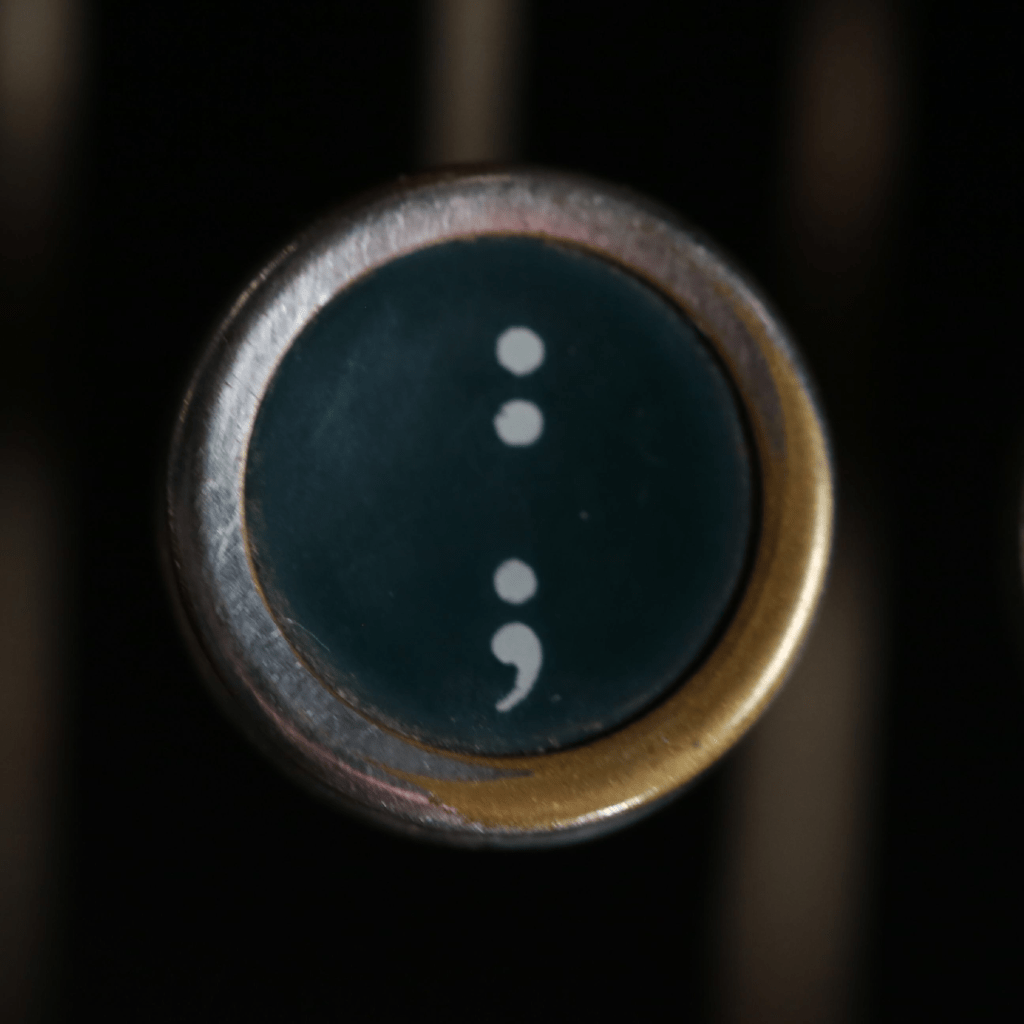
So what is the semicolon, then? How do you use it? Confidently? With withering effect? For example, I like using it in emails with someone I’m rather annoyed with, as a flex. Like yes: I do, in point of fact, know exactly how to use the semicolon; I’m that person. First, a little delightful history:
The semicolon was born in Venice in 1494. It was meant to signify a pause of a length somewhere between that of the comma and that of the colon, and this heritage was reflected in its form, which combines half of each of those marks. It was born into a time period of writerly experimentation and invention, a time when there were no punctuation rules, and readers created and discarded novel punctuation marks regularly.
That was delightful, wasn’t it? Cecelia Watson has written a whole book on the topic; I’ll report back and let you know how good it is.
The semicolon saves you from the comma splice—it’s what you need when you’re writing complex sentences, along with the m-dash and the colon. It’s in your fancy trick-bag, as a writer; it’s the hire-wire act. It says: I’m writing more than simple sentences; I’ve got two complete thoughts here, two independent clauses, and they belong together, so close their logic is!
The semicolon is about intimacy; it joins two (or more) sentences which belong together, closer than a period; the writer wants you to see something about the sentences, together. The semicolon can also function as a comma in a list of things, particularly in British usage—we see this in Virginia Woolf’s writing, frequently; I love the way the semicolon glitters down the page in Woolf’s prose.
On Of Poetry Podcast, the poet Carla Sofia Ferreira says she teaches the semicolon versus the comma splice as a marriage versus a toxic relationship. Carla also has a lovely “Ode to the Semicolon” poem in her book A Geography That Does Not Hurt Us (River River Books, 2024)! Read Carla’s poem below, and then enjoy a semicolon writing prompt.
Writing prompt: Write a piece either about the semicolon WITHOUT using the semicolon, or write a piece where you abundantly use the semicolon. ENJOY. REVEL IN PUNCTUATION MARKS. Extra points for writing your piece by hand, or in an interesting font. Extra points for mentioning a historical fact.
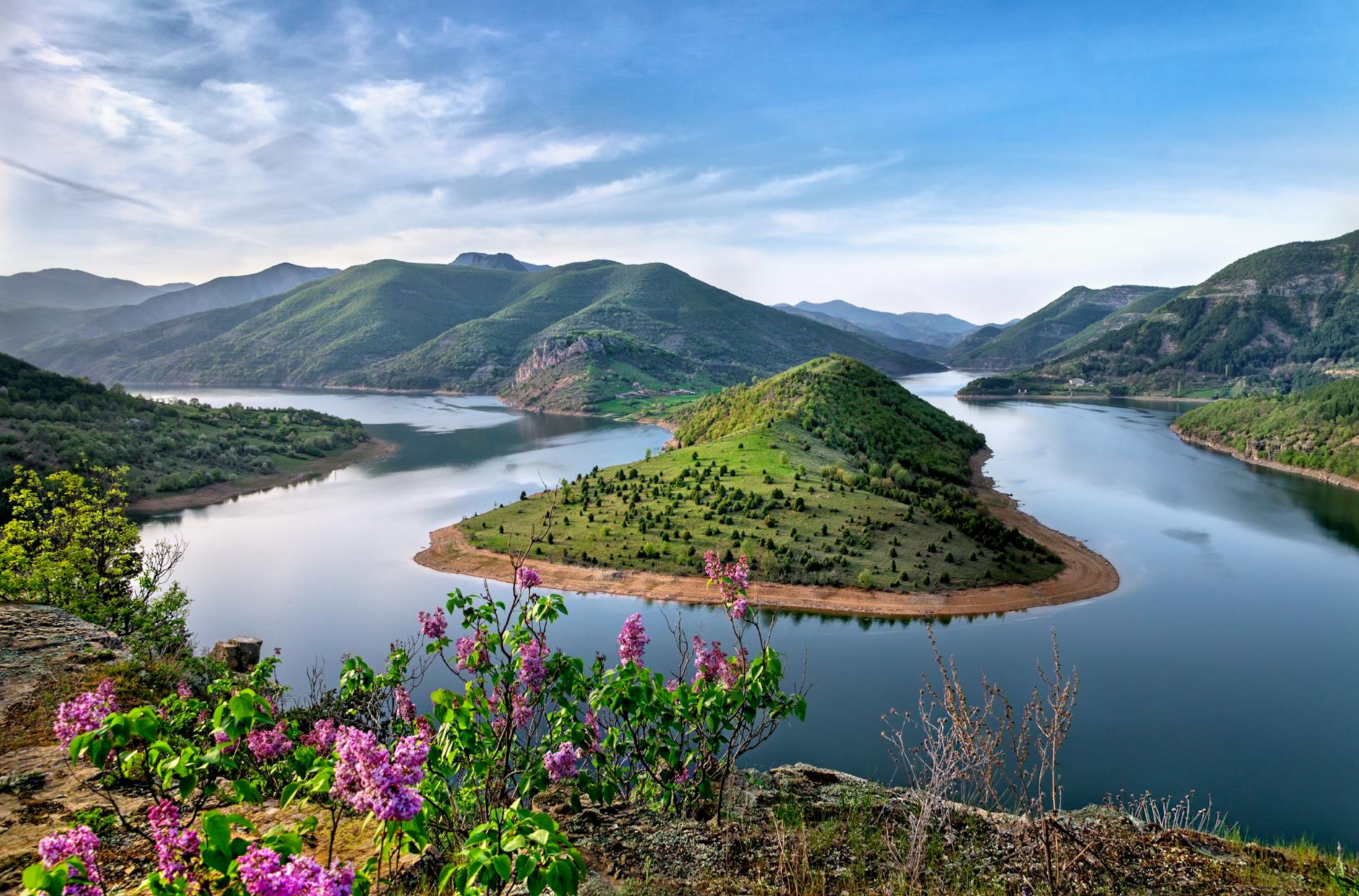
They look at each other across the glittering sea some keep a low profile
Some are cliffs The bathers think islands are separate like them
Poetry reminds me how connected we are—even in our loneliness, our quietness. Even as we read a poem by ourselves, we are connected by language to others (the writer, other readers). In Muriel Rukeyser’s poem “Islands,” the islands in the “glittering sea,” although they look physically separate, viewed distantly (objectively?) from above, are “connected / underneath.” The last couplet of the poem, “The bathers think / islands are separate like them” reveals a flaw in human looking and attention and analogy: that the bathers apply the same logic they apply to themselves, a logic of separateness and individuality, to the islands. The emphasis of the poem, an emphasis which is not a proof, returns us to connection and the deep feeling of the opening lines: “O for God’s sake / they are connected /underneath.”
Writing prompt: write a piece (poem or paragraph that could begin a story, an essay) where a physical or environmental aspect offers a point of connection—a landbridge, a beach, a cup of something warm, a wind, a puddle of tadpoles at the park. Extra points for writing a three-stanza poem, like Rukeyser.
I’ve been reading Denise Levertov’s The Poet in the World (which features this essay), a book that was once an influential text in terms of teaching poetry in college and MFA programs. The other night, sleepy, just drifting off, I was reading the conclusion of a talk Levertov delivered in 1970 entitled “Great Possessions,” and I found myself waking up, because what she says in the following paragraphs is so true, so pertinent to now, and I feel like so few academics are brave enough to say what Levertov says, and how she says it.
The TL;DR: poetry is not at all about our safety or our comfort—but about our authentic living, our surviving as communities, about the quality of our life together on this fragile earth.
Even briefer TL;DR: you want to write good poetry? You have to risk (your time, your money, probably what you think of as your reputation).
Writing prompt: after reading the below excerpt from Levertov’s talks (I promise you, it is worth it—WORTH. IT. FOR. YOUR. SOUL!) write a poem where you RISK, where you SAY what you would not SAY to ANYONE ELSE. You are not SHOWING this POEM to ANYONE. You are WRITING IT. You are SAYING THE THING, WHATEVER IT IS. You are RISKING. You can burn the poem after, (safely!) in your sink or backyard firepit or something. You can keep it in your journal. You can put it under your pillow and sleep on it and let it seep into you and make you braver. But you will have risked and articulated and accomplished some incredibly important selfwork for you and your poetry. You need to ride that language edge out—you need to dare. If your nerve deny you, wrote Emily Dickinson, go above your nerve. Bonus points if you add a living flower or shrub or plant in your poem—name it. It will be your witness plant.
Happy National Poetry Month!
Since I believe there is a most intimate relationship between the quality of a person’s life, its abundance or sterility, his integrity, and the quality of his poetry, it is not irrelevant to say that, judging by some—not a few—I have met on my travels, the people who write banal poetry and, to almost the same extent, those who in desperation make up a fake surrealism, usually seem to be the same academics who talk a liberal line concerning education and politics (and often, as teachers, are genial and popular) but who, when it comes to some crucial issue, such as a student protest, will not commit themselves far enough to endanger their own security. Which comes first, the chicken or the egg? Is their poetry banal because their lives are banal, or vice versa? I think it works both ways. If these people committed themselves, took risks, and did not let themselves be dominated by the pursuit of “security,” their daily lives would be so changed, so infused with new experiences and with the new energy that often comes with them, that inevitably their poetry would change too (though obviously this would not ensure better poems unless they were gifted in the first place). But on the other hand, if they could manage to put themselves in a new, more dynamic, less suppressive relationship to their own inner lives and to the language, then they might discover their outer lives moving in a revolutionary way. So the process is dual, and can be approached from either direction.
And for myself—not without anguish, not without fear, not without the daily effort of rousing myself out of the inertia and energy—apping nostalgia that would cling to old ways, to that dying bird-in-hand that’s falsely supposed to be worth two free ones chirping in the bushes—I believe our survival demands revolution, both cultural and political.
If we are to survive the disasters that threaten, and survive our own struggle to make it new—a struggle I believe we have no choice but to commit ourselves to—we need tremendous transfusions of imaginative energy. If it is indeed revolution we are moving toward, we need life, and abundantly we need poems of the spirit, to inform us of the essential, to help us live the revolution. And if instead it be the Last Days—then we need to taste the dearest, freshest drops before we die-why bother with anything less than that, the essential?
Wallace Stevens wrote, “The poet feels abundantly the poetry of everything.” We must not go down into the pit we have dug ourselves by our inhumanity without some taste, however bitter, of that abundance. But if there is still hope of continued life on earth, of a new life, the experience of that abundance which poetry can bring us is a revolutionary stimulus. It can awaken us, from our sloth, even yet.
What better way to celebrate poetry than simply by reading poetry? You don’t have to spend money–not on books, or fancy notebooks or pens, or lattes in adorable coffee shops–although those are all delightful things. The fact is that a library offers you stacks of free poetry to read, and also that, as Eugenio Montale said, all you need to write poetry is a piece of paper and a pencil. Poetry is indeed for the people, and no fancy degree can buy you poetry.
Here is a favorite poem of mine to read–a love poem by the incredible poet Donika Kelly, originally published in Pleiades Magazine. As a writing prompt: try your hand at a love poem (or any kind of poem!) in the voice of a mythical creature or figure.
Love Poem: Centaur
Nothing approaches a field like me. Hard
gallop, hard chest—hooves and mane and flicking
tail. My love: I apprehend each flower,
each winged body, saturated in a light
that burnishes. I would make a burnishing
of you, by which I mean a field in flower,
by which I mean, a breaching—my hands
making an arrow of themselves, rooting
the loosened dirt. I would make for you
the barest of sounds, wing against wing,
there, at the point of articulation. Love,
I pound the earth for you. I pound the earth.
Why do we want to write poems? What is behind this crazy impulse? The wish to connect with others, on a deep level, about inward things.
The pressure of emotion, which many people prefer to ignore, but which, for you, is the very substance of your work, your clay.
There’s play involved in the writing of poetry. Baby waking up. We have to be like babies waking up–trying every sound, every pitch, every word, however nonsensical. Later, be a revising adult. Babies build it up and knock it down again.
There’s the need to make sense of life behind the impulse to write.
And finally, we celebrate the world by writing about it, we observe it more closely, with more love. We are more fully alive and aware because of our efforts.
Jane Kenyon, “Everything I Know About Writing Poetry”
We are at midterms, writing papers, taking tests, submitting journal prompts, turning in many assignments, feeling overwhelmed. So, my writing prompt for you this week is to sit down and take all the pressure off yourself to do something great or achieve something. Instead, let your mind play. Let it wander. Let it use sound like colorful blocks, like a toddler builds and knocks over, shrieking with delight at their own creations and destructions. Begin with something you’ve noticed lately. Maybe the bradford pear or sugar maple is budding. Maybe you watched the black capped chickadees eat in the sweetgum branches out the dentist office window. Maybe the sky was grey and depressing this morning, but you were listening to your favorite song, and the contrast was pleasant. Journal for a little while, and see if you have the beginning of a poem or a story or an essay. Remember that the way to the universal is through the local. Remember to be a baby, waking up.
In recent years, wind turbine projects have met massive local opposition, which has resulted in several being stopped. One of the dominant arguments often used against wind turbine projects is that they destroy the Danish idyll. But if we continue as we are now, our beautiful landscape will be threatened by warmer summers, wilder weather and violent water rises. We have therefore reached the point where our image of the Danish landscape must and must change if we want to preserve the Danish idyll that we know and love.
What happens when technology–particularly-energy conserving technology–is dropped into an idyllic landscape? Particularly when that technology affects something we view as worthy of preservation and conservation: a beach scene, a forest, a wilderness, a cave painting? Doesn’t it pull against our hearts? Shouldn’t it? Consider the below scene, and how it is unsettled by the anachronism (anachronism: a person or a thing that is chronologically out of place) of the wind turbines.
Writing Prompt: Write about a landscape with an intrusion, with something else dropped in, with something that should not be there, with something that your heart wants to reject or eject or push or pull out. Landscape with Weeds. Landscape with the Fall of Icarus. Landscape with Oil Spill. Landscape with a Field of Energy-Saving Wind Turbines. Landscape with Cell Phone Towers Shaped Like Trees. This could be a story or a poem or an essay or a journal entry, or whatever you want it to be. Let the animals loose.
I’m not going to lie…Kendrick Lamar has art as protest on my mind. Art as subversion, as layered as a rose. Art as showing up, as voice-giving. Art as documentation of harm. Art as a shout, a stomp, a crip walk. And then I saw this image of a policeman at a protest, taken by mid-20th century photograph Dorothea Lange (1895-1965), and oh, I knew we should write about it:
Description: A uniformed policeman standing in front of a dense crowd of men holding protest signs in English and Japanese nearly fills the height of this vertical black and white photograph. The policeman either has a ruddy complexion or his face might be in shadow. He stands with his body facing us but he turns his head to our left in profile. His hands are crossed over his chest and one thumb is hooked into his jacket between two of the eight brass buttons down the front. A seven-pointed star reflects light on his chest and his flat-topped hat has a short, shiny brim angled down over his eyes. The jacket comes to his knees and his pants are lined with gold or other light material down the side. His feet are widely planted, and he wears dark shoes. The men in the crowd behind appear to be light skinned. Many wear button-down, collared shirts with ties tucked into long coats. Many also wear fedora hats and look off to our left, the same direction as the policeman. One man to our right wearing a floppy cap and glasses looks out at us with his hands in his jacket pockets. Some of the legible English words on the protest signs read “UNION,” “AMERICAN PRESS SLANDER against the,” and “JA.”
There is another photograph of a policeman, with even more posture in it, can you believe it:
Writing Prompt: Using the above photographs as your inspiration, write a poem or a story where you focus on power and its postures, its poses, its uniforms–even if you very gently fold this examination into, say, a schoolyard where children are playing during recess. Consider how power and gesture work, also how the lens of a camera works: what it looks at, who it looks at and considers, the angle of its gaze, whether it looks from above or below or at equal-height with its subject, or from behind, or before. Who is in the foreground? The background? What kind of sounds can you hear? What scents of the city can you smell, or in the scene in the story/poem you are writing? Let your imagination go.







 The Line Break