What does a comma do. I have refused them so often and left them out so much and did without them so continually that I have come finally to be indifferent to them. I do not now care whether you put them in or not but for a long time I felt very definitely about them and would have nothing to do with them.
As I say commas are servile and they have no life of their own, and their use is not a use, it is a way of replacing one’s own interest and I do decidedly like to like my own interest my own interest in what I am doing. A comma by helping you along holding your coat for you and putting on your shoes keeps you from living your life as actively as you should lead it and to me for many years and I still do feel that way about it only now I do not pay as much attention to them, the use of them was positively degrading. Let me tell you what I feel and what I mean and what I felt and what I meant.
No one has ever accused Gertrude Stein—her memory IS a blessing, dear reader—of having too few feelings when it comes to punctuation. I adore Stein’s remarks, rambles, thoughts, observations, and passionate recollections of her life lived with punctuation. Particularly the much-maligned comma. I always tell my writing students: “Gertrude Stein didn’t use commas because she said her readers knew when to breathe” (it’s true; see the block quote a little further down). But it’s probably more truthful to say that Stein enjoyed the adventure of the page and the sentence without direction, like not receiving a program for a theater or musical performance. Don’t spoil the arrangement for Stein: let her discover whatever is about to happen. But I also love how Stein describes the work of the comma, even while she is giving it a good bashing as being “servile”—after all, isn’t it nice, sometimes, to have someone or something be attentive to you? Someone to hold your coat? Bring you a cup of coffee? Put your shoes on? I think, in this hard life, we deserve a little ease. Especially in a college essay, or in a piece where clarity and organization are of utmost importance. As Rules for Writers gently suggests, “The comma was invented to help readers” (Diana Hacker, 266). All punctuation is about musical notation—how long we are pausing between our words, phrases, and sentences—and while the comma offers us a minor pause, it is a useful one. I wrote this about the comma:
Oh, the sweet comma. The pause. It sets apart phrases. It helps you list items, say names, dates, and places, and be clear and organized. It also lets your reader (and you) breathe. Read your work aloud, and notice your pauses. But don’t place a comma simply because you stopped typing.
Stein has more to say about the comma and, tellingly, she even indulges us with using a few commas as she does so. I think this is a lovely note to close on, because it opens the door to the pleasure of complicated sentences, and turns use away from use, and towards pleasure. After all, on the spectrum of use and pleasure, explicitly creative writing (essays, poetry, screenplays, short stories, novels, graphics) bends towards pleasure, and away from usefulness. So I will close this brief piece on the comma with Stein championing the complicated sentence, and the pleasures of forgoing the comma, even while using the comma, and showing that sometimes, you just need a sweet, minor pause:
A long complicated sentence should force itself upon you, make you know yourself knowing it and the comma, well at the most a comma is a poor period that lets you stop and take a breath but if you want to take a breath you ought to know yourself that you want to take a breath. It is not like stopping altogether has something to do with going on, but taking a breath well you are always taking a breath and why emphasize one breath rather than another breath. Anyway that is the way I felt about it and I felt that about it very very strongly. And so I almost never used a comma. The longer, the more complicated the sentence the greater the number of the same kinds of words I had following one after another, the more the very more I had of them the more I felt the passionate need of their taking care of themselves by themselves and not helping them, and thereby enfeebling them by putting in a comma.
Writing prompt: Write a prose poem/paragraph or lineated poem (written in lines) without commas. Observe what happens when you write without the comma. What other punctuation do you use? How do you replace the comma? Do your sentences shorten? Do they stay the same? If you choose to lineate your piece, do you use the poetic line/lineation as a comma replacement? Extra points for including a seasonal (it’s October) flower.
The colon introduces new material: ta da! It can also introduce a list, a quotation, a summary or explanation. It’s direct in tone, and draws attention to what follows it. I love its bluntness, it’s honesty. So often, students ask me—
“Will I get in trouble for using this punctuation mark? Can I overuse this mark?”
“You don’t get in trouble for using a period,” I tell them. Today I told a student that they are getting in trouble because they are using a comma when they should be using colons, semicolons and em-dashes. Your sentences are more complex than that—which is a good thing, I reminded them. Time to play with more advanced punctuation, because your sentences are growing up from simple sentences.
I worry that college comp courses seek to iron out what is interesting in a student’s writing—the expressive fragments, the musical repetitions, the comma splices that are doing interesting work (check out Alice Notley, who regularly uses comma splices, ha). Learn the rules of grammar and punctuation so you can PLAY, y’all. It’s like learning the rules of the road and physics so you can then race a car or a bike—let’s learn the basics so that we can get to the FUN STUFF. The fundamentals matter, absolutely: but so does advanced play.
The colon, that sign of “ongoingness,” is Ammons’s characteristic punctuation mark
William Doreski
Consider how A.R. Ammons plays with the colon, to open the grammatical and poetic doors of the sentence:
Still by A.R. Ammons
I said I will find what is lowly
and put the roots of my identity
down there:
each day I'll wake up
and find the lowly nearby,
a handy focus and reminder,
a ready measure of my significance,
the voice by which I would be heard,
the wills, the kinds of selfishness
I could
freely adopt as my own:

but though I have looked everywhere,
I can find nothing
to give myself to:
everything is

magnificent with existence, is in
surfeit of glory:
nothing is diminished,
nothing has been diminished for me:

I said what is more lowly than the grass:
ah, underneath,
a ground-crust of dry-burnt moss:
I looked at it closely
and said this can be my habitat: but
nestling in I
found
below the brown exterior
green mechanisms beyond the intellect
awaiting resurrection in rain: so I got up

and ran saying there is nothing lowly in the universe:
I found a beggar:
he had stumps for legs: nobody was paying
him any attention: everybody went on by:
I nestled in and found his life:
there, love shook his body like a devastation:
I said
though I have looked everywhere
I can find nothing lowly
in the universe:

I whirled through transfigurations up and down,
transfigurations of size and shape and place:

at one sudden point came still,
stood in wonder:
moss, beggar, weed, tick, pine, self, magnificent
with being!
Writing prompt: Use a colon in a piece of writing (poem or paragraph) to open into a new grammatical vista: use it in a surprising way: show us something new!
The em-dash (called this because it takes up the width of an “m,” as opposed to the “n-dash,” and it’s lesser cousin, the hyphen) is the dramatic pause. It can be used to set off parenthetical material; an em-dash can also be used to introduce a list—for examples—apples, pears, cherries, or to introduce a restatementement, or a dramatic shift in tone or thought.
No one loves the m-dash so much as the poets, though. “Don’t take that, it’s my emotional support em-dash,” you can practically hear the poet writing an essay thinking. Why do poets love the em-dash? It allows us a break—mid-thought, mid-description, mid-line. It offers us one more element of play when it comes to something that runs counterpoint to the function of the line’s shape in poetry—the em-dash is the music of disruption. Ask Emily Dickinson, who used lots of different shapes and lengths of dashes, writing her poems in long-hand, and stitching them together in little books known as fascicles.
One of the backhanded gifts of increased ChatGPT usage is that I am having more students than ever asking me what the em-dash and the semicolon are for, and how they work. Another thing I find myself pointing out lately is that if you find yourself writing run-on sentences and comma splices, it means you are writing complex sentences that need more interesting punctuation, which is a great thing—and the em-dash and the semicolon are here to help! Not that the period isn’t also here to help; who doesn’t love to rest with a full-stop and a period?
Like the semicolon, the em-dash gets you out of the comma-splice bind, and can also set apart parenthetical statements (we have all met the professor or editor who disdains parentheses for whatever reason, but who seems oddly fine with dashes). Go forth and live life with your best flourish!
Writing prompt: Use an em-dash today. Bonus points for writing a poem with an em-dash (or maybe an em-dash on every line! why be modest when you can BE BOLD!). Bonus points for using an em-dash in a text to a friend, leaving them hanging in dramatic suspense for a minute—
remember, two hyphens and a space will usually autoformat an em-dash for you! otherwise you can easily find an em-dash in the internet wilds; go to the em-dash fields, my writer friend, harvest an em-dash.
I’ve decided to write a series about punctuation marks, in large part because punctuation has become the white rhino of our writing lives these days—endangered by tool-wielding humans. Autocorrect is ready to fix it for you—often against your will and best-intention, and ChatGPT and Copilot are more than willing to replace your commas with semicolons and m-dashes. Which is a problem for many new writers who are not yet entirely comfortable with these punctuation marks, long associated with complex sentences and daredevil grammatical moves.
“Why did you use this mark here?” I ask.
“I don’t know,” is often the sheepish reply.
Because in reality, ChatGPT has become the greatest user of the semicolon and the m-dash in student essays—and students are aware. Last week, a student who showed a natural inclination towards the semicolon in their writing confessed to me that they were avoiding the semicolon, because the presence of a semicolon would mark their essay as being written by ChatGPT. I pointed out that a) their instructor had told them to put their essay into ChatGPT for style and grammar correction b) ChatGPT would add semicolons c) how much better to add semicolons oneself to one’s writing d) they couldn’t let their anxiety of ChatGPT’s style control and dictate their own writing style, PARTICULARLY when ChatGPT is applying a Frankenstein of style rules it has stolen from other writers’ texts.
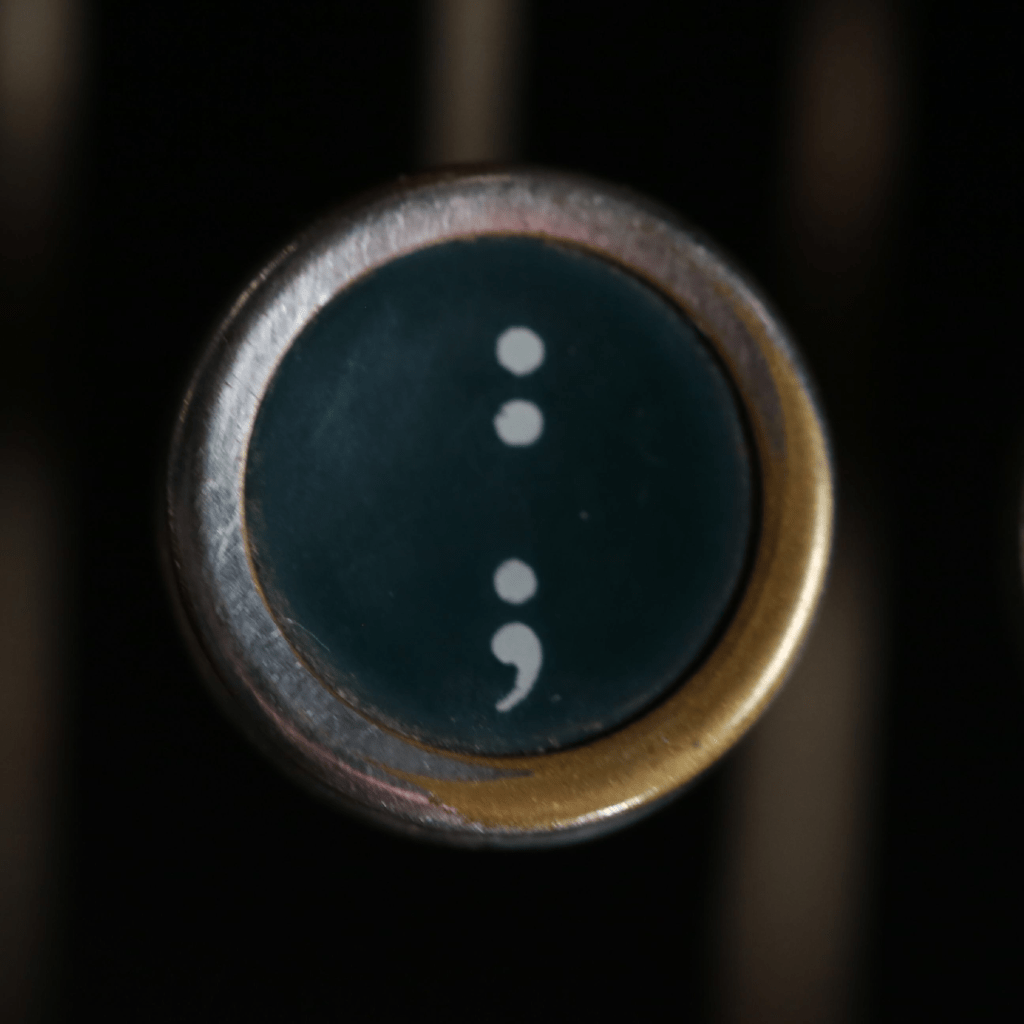
So what is the semicolon, then? How do you use it? Confidently? With withering effect? For example, I like using it in emails with someone I’m rather annoyed with, as a flex. Like yes: I do, in point of fact, know exactly how to use the semicolon; I’m that person. First, a little delightful history:
The semicolon was born in Venice in 1494. It was meant to signify a pause of a length somewhere between that of the comma and that of the colon, and this heritage was reflected in its form, which combines half of each of those marks. It was born into a time period of writerly experimentation and invention, a time when there were no punctuation rules, and readers created and discarded novel punctuation marks regularly.
That was delightful, wasn’t it? Cecelia Watson has written a whole book on the topic; I’ll report back and let you know how good it is.
The semicolon saves you from the comma splice—it’s what you need when you’re writing complex sentences, along with the m-dash and the colon. It’s in your fancy trick-bag, as a writer; it’s the hire-wire act. It says: I’m writing more than simple sentences; I’ve got two complete thoughts here, two independent clauses, and they belong together, so close their logic is!
The semicolon is about intimacy; it joins two (or more) sentences which belong together, closer than a period; the writer wants you to see something about the sentences, together. The semicolon can also function as a comma in a list of things, particularly in British usage—we see this in Virginia Woolf’s writing, frequently; I love the way the semicolon glitters down the page in Woolf’s prose.
On Of Poetry Podcast, the poet Carla Sofia Ferreira says she teaches the semicolon versus the comma splice as a marriage versus a toxic relationship. Carla also has a lovely “Ode to the Semicolon” poem in her book A Geography That Does Not Hurt Us (River River Books, 2024)! Read Carla’s poem below, and then enjoy a semicolon writing prompt.
Writing prompt: Write a piece either about the semicolon WITHOUT using the semicolon, or write a piece where you abundantly use the semicolon. ENJOY. REVEL IN PUNCTUATION MARKS. Extra points for writing your piece by hand, or in an interesting font. Extra points for mentioning a historical fact.




 The Line Break