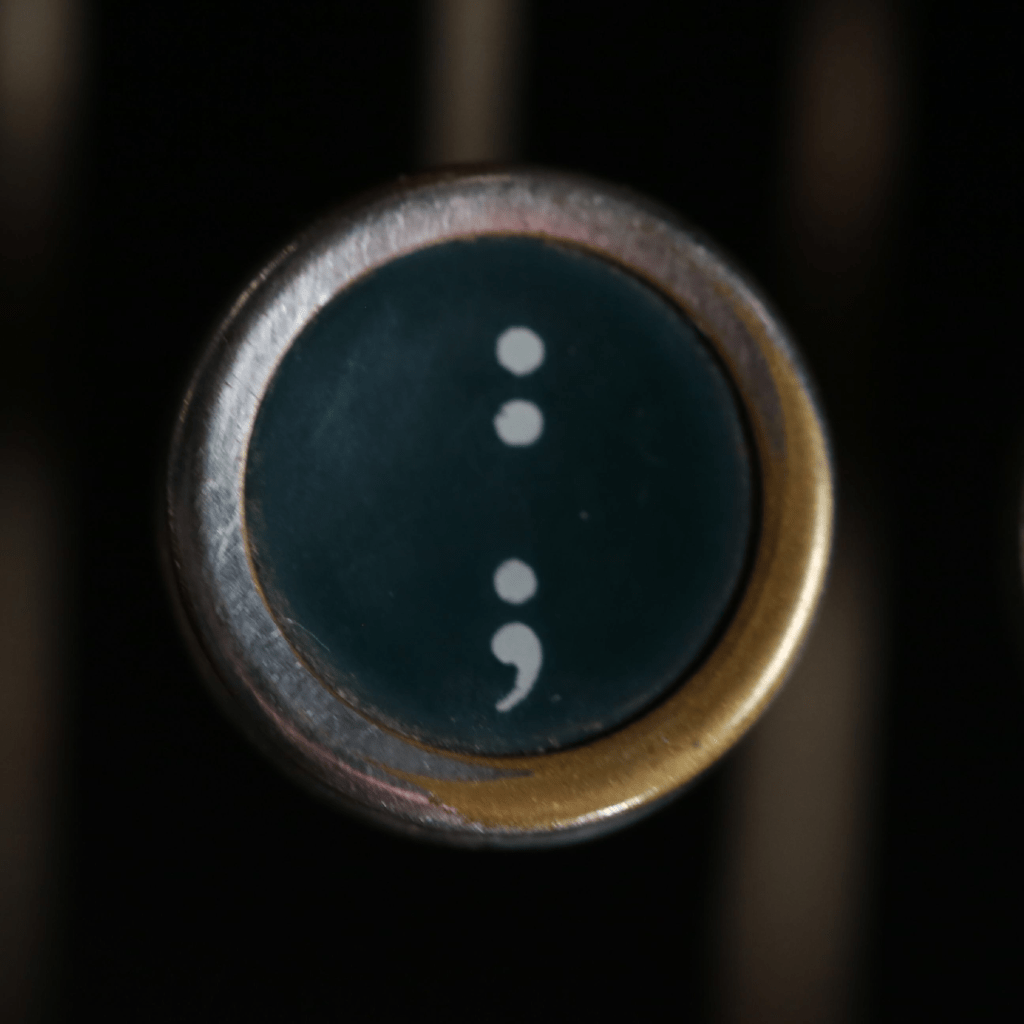
I’ve decided to write a series about punctuation marks, in large part because punctuation has become the white rhino of our writing lives these days—endangered by tool-wielding humans. Autocorrect is ready to fix it for you—often against your will and best-intention, and ChatGPT and Copilot are more than willing to replace your commas with semicolons and m-dashes. Which is a problem for many new writers who are not yet entirely comfortable with these punctuation marks, long associated with complex sentences and daredevil grammatical moves.
“Why did you use this mark here?” I ask.
“I don’t know,” is often the sheepish reply.
Because in reality, ChatGPT has become the greatest user of the semicolon and the m-dash in student essays—and students are aware. Last week, a student who showed a natural inclination towards the semicolon in their writing confessed to me that they were avoiding the semicolon, because the presence of a semicolon would mark their essay as being written by ChatGPT. I pointed out that a) their instructor had told them to put their essay into ChatGPT for style and grammar correction b) ChatGPT would add semicolons c) how much better to add semicolons oneself to one’s writing d) they couldn’t let their anxiety of ChatGPT’s style control and dictate their own writing style, PARTICULARLY when ChatGPT is applying a Frankenstein of style rules it has stolen from other writers’ texts.
So what is the semicolon, then? How do you use it? Confidently? With withering effect? For example, I like using it in emails with someone I’m rather annoyed with, as a flex. Like yes: I do, in point of fact, know exactly how to use the semicolon; I’m that person. First, a little delightful history:
The semicolon was born in Venice in 1494. It was meant to signify a pause of a length somewhere between that of the comma and that of the colon, and this heritage was reflected in its form, which combines half of each of those marks. It was born into a time period of writerly experimentation and invention, a time when there were no punctuation rules, and readers created and discarded novel punctuation marks regularly.
Cecelia Watson, The Paris Review
That was delightful, wasn’t it? Cecelia Watson has written a whole book on the topic; I’ll report back and let you know how good it is.
The semicolon saves you from the comma splice—it’s what you need when you’re writing complex sentences, along with the m-dash and the colon. It’s in your fancy trick-bag, as a writer; it’s the hire-wire act. It says: I’m writing more than simple sentences; I’ve got two complete thoughts here, two independent clauses, and they belong together, so close their logic is!
The semicolon is about intimacy; it joins two (or more) sentences which belong together, closer than a period; the writer wants you to see something about the sentences, together. The semicolon can also function as a comma in a list of things, particularly in British usage—we see this in Virginia Woolf’s writing, frequently; I love the way the semicolon glitters down the page in Woolf’s prose.
On Of Poetry Podcast, the poet Carla Sofia Ferreira says she teaches the semicolon versus the comma splice as a marriage versus a toxic relationship. Carla also has a lovely “Ode to the Semicolon” poem in her book A Geography That Does Not Hurt Us (River River Books, 2024)! Read Carla’s poem below, and then enjoy a semicolon writing prompt.


Writing prompt: Write a piece either about the semicolon WITHOUT using the semicolon, or write a piece where you abundantly use the semicolon. ENJOY. REVEL IN PUNCTUATION MARKS. Extra points for writing your piece by hand, or in an interesting font. Extra points for mentioning a historical fact.

 The Line Break
Leave a reply to The Punctuation Series: The Colon – The Line Break Cancel reply